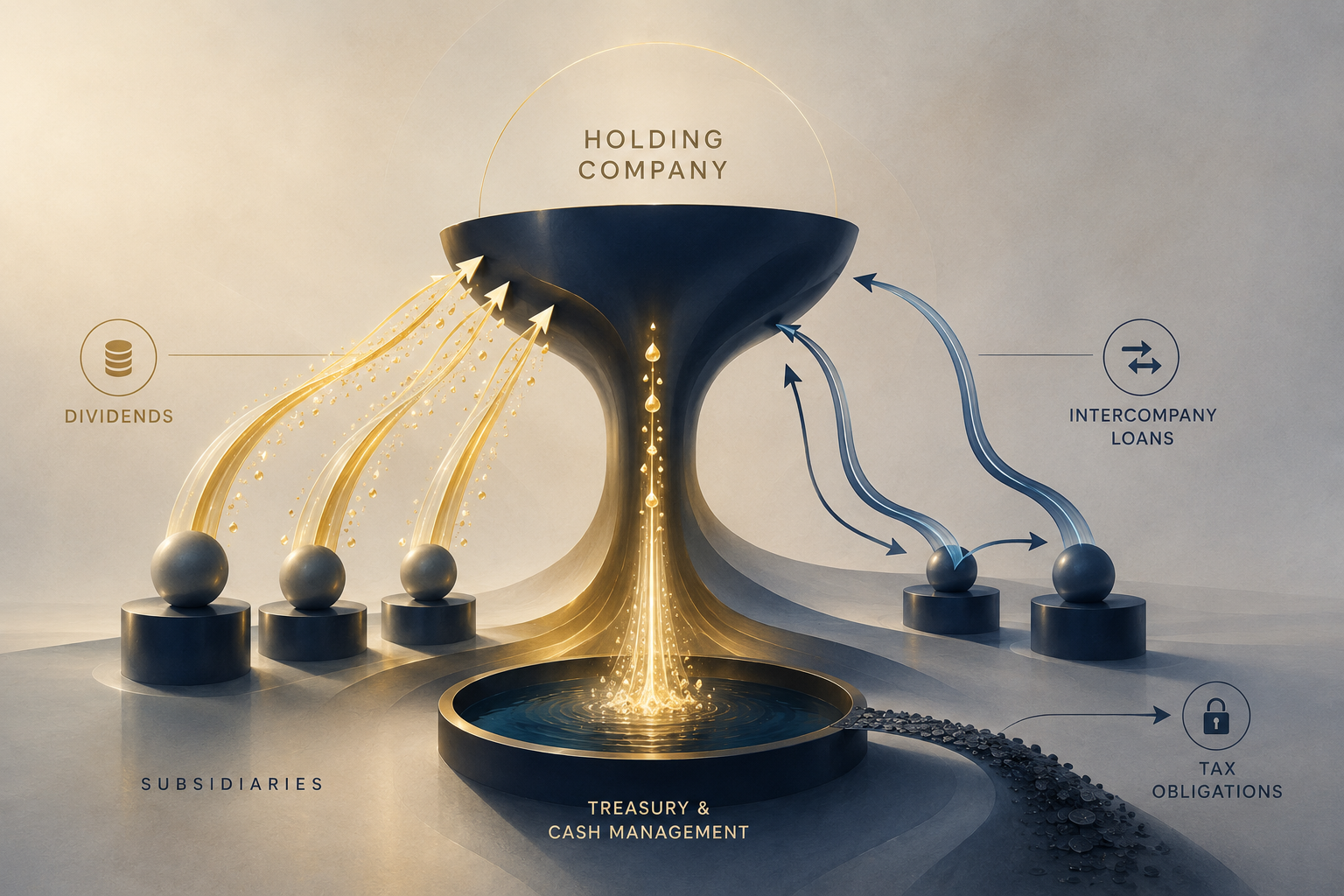
A holding company often begins with a simple purpose: to hold cash or investments outside an operating business. Over time, it may come to own stocks, bonds, GICs, investment funds or other assets.
If you find yourself responsible for a holding company, the tax rules can seem intimidating at first. The good news is that you don’t need to be a tax expert. You do, however, need to understand a few basic ideas, especially before taking money out of the company.
Holding companies pay tax too
Canada’s tax system generally tries to produce a similar overall tax result whether you earn investment income personally or through a corporation.
When a holding company earns income, there may be two stages of tax:
- The company pays corporate tax on its investment income.
- You may pay personal tax when the company distributes money to you.
The system includes several adjustments and potential corporate tax refunds to prevent the same income from being fully taxed twice. This is known as tax integration.
Integration is not exact, and the results vary by province and type of investment. The main benefit of a holding company is often the ability to delay personal tax by leaving money inside the company. It is usually a tax deferral and not a way to avoid tax forever.
Different investments produce different kinds of income
The tax treatment depends less on what the holding company owns and more on what kind of income the investment produces.
Interest income
Interest from bonds, GICs, savings accounts and private loans is fully taxable to the holding company.
This type of income is generally taxed more heavily than capital gains. Some of the corporate tax may eventually be refunded when the company pays a taxable dividend to you, but until then, that money remains with the government.
Interest-paying investments may still be appropriate based on your investment goals. The important point is that they are not usually the most tax-efficient investments for a holding company.
Canadian dividends
Dividends received from Canadian companies receive special tax treatment because the company paying the dividend has already paid corporate tax on its earnings.
A holding company may have to pay some temporary corporate tax when it receives these dividends. That tax may later be refunded when the holding company pays dividends to you.
Some Canadian dividends may also allow your holding company to pay you a dividend that receives better personal tax treatment.
Dividends from Canadian public companies are called “eligible dividends”.
Capital gains
A capital gain occurs when the company sells an investment for more than it paid.
Only part of a capital gain is included in the company’s taxable income. The other part may be added to a special tax balance that can eventually be paid to a Canadian-resident shareholder as a tax-free capital dividend.
This tax account is called a “capital dividend account”. It is a tax account used to keep track of the amount that can be distributed to shareholders tax free.
This can make capital gains more tax-efficient than interest income.
Foreign income
Interest and dividends from foreign investments are generally fully taxable to the holding company.
The foreign country may also withhold tax before the income reaches Canada. The company may be able to claim a credit for some of that foreign tax, but the rules can be complicated.
Foreign investments can still be an important part of a diversified portfolio. They simply require additional tax reporting and may be less tax-efficient than Canadian dividend-paying investments.
Investment funds and ETFs
A mutual fund or exchange-traded fund may distribute several kinds of income at once, including interest, Canadian dividends, foreign income, capital gains and return of capital.
Each part is taxed differently. The bookkeeping may therefore be more complicated than the cash distribution shown on the investment statement.
Good tax records are especially important for funds that regularly distribute return of capital, because those distributions reduce the recorded tax cost of the investment.
Three important balances to understand
A holding company may have several tax balances that do not appear as separate bank accounts. They are records maintained for tax purposes.
You do not need to calculate them yourself, but you should know that they exist.
The capital dividend balance
This balance is commonly called the capital dividend account. It usually grows when the company realizes capital gains because the non-taxable portion of the gain is added to it.
Certain life insurance proceeds and tax-free capital dividends received from other companies may also increase the balance.
If the proper paperwork is completed, the company can use this balance to pay a tax-free capital dividend to a Canadian-resident shareholder.
The amount must be calculated carefully. Paying more than the available balance can result in a large penalty. A capital dividend should never be declared without first having the company’s accountant confirm the balance and prepare the required documents.
The refundable tax balance
A holding company may build up refundable tax when it earns investment income or receives Canadian dividends.
The company can recover this tax only after paying sufficient taxable dividends to its shareholders. It cannot simply ask the government to refund the balance while leaving all the money inside the company.
The shareholder loan balance
A shareholder loan records money that the shareholder and the company owe one another.
If you previously lent personal, after-tax money to the holding company, the company may be able to repay that loan without the repayment being treated as salary or a dividend. The payment is simply the return of money the company already owes you.
For example, if you lend $300,000 to your holding company and the loan is properly recorded, the company may later repay that $300,000 without creating additional personal income.
This can provide considerable flexibility, but the loan must be real and properly documented. Once the company has repaid the full amount, additional withdrawals cannot continue to be called loan repayments.
Be careful when borrowing from the company
There is an important difference between:
- money you lent to the holding company; and
- money you borrowed from the holding company.
If the company owes you money, it may be able to repay that debt without additional tax.
If you owe the company money, the amount may be included in your personal taxable income unless it qualifies for a limited exception or is repaid within the required period.
Repeatedly repaying and then re-borrowing the same money generally does not solve the problem. Personal expenses paid by the company may also be treated as amounts you borrowed or received from it.
Before withdrawing money as a “shareholder loan,” ask your accountant who owes whom and what the current loan balance is.
Ways to take money out of a holding company
Money can generally come out of a holding company in several ways:
- repayment of money the company owes you (from a shareholder loan);
- a tax-free capital dividend, if the necessary balance is available;
- a regular taxable dividend;
- a taxable dividend that receives more favourable personal tax treatment; or
- salary or a bonus, where appropriate.
Each method has different consequences.
Salary may create RRSP contribution room and pension benefits, but it is personally taxable and may involve payroll deductions. Dividends do not create RRSP room. A taxable dividend may help the company recover refundable tax. A capital dividend may be received tax-free. A shareholder loan repayment may also be tax-free, but only to the extent the company genuinely owes you money.
The best answer is often a combination of these methods rather than relying on only one.
Start with four questions
Before making a large withdrawal or changing the company’s investments, ask your accountant:
- How much does the company owe me as a shareholder loan?
- How much can the company currently pay as a tax-free capital dividend?
- Does the company have refundable tax that could be recovered by paying a taxable dividend?
- What type and amount of payment would be most appropriate for my personal tax situation?
A holding company can provide useful flexibility, but also comes with some constraints, and the flexibility depends on accurate records and advance planning. The most expensive mistakes often occur when money is withdrawn first and the tax treatment is considered afterward.
You don’t need to understand every tax form or technical term. You do need to know that interest, Canadian dividends, foreign income and capital gains are treated differently, and that the way money leaves the company can be just as important as the investments it owns.