
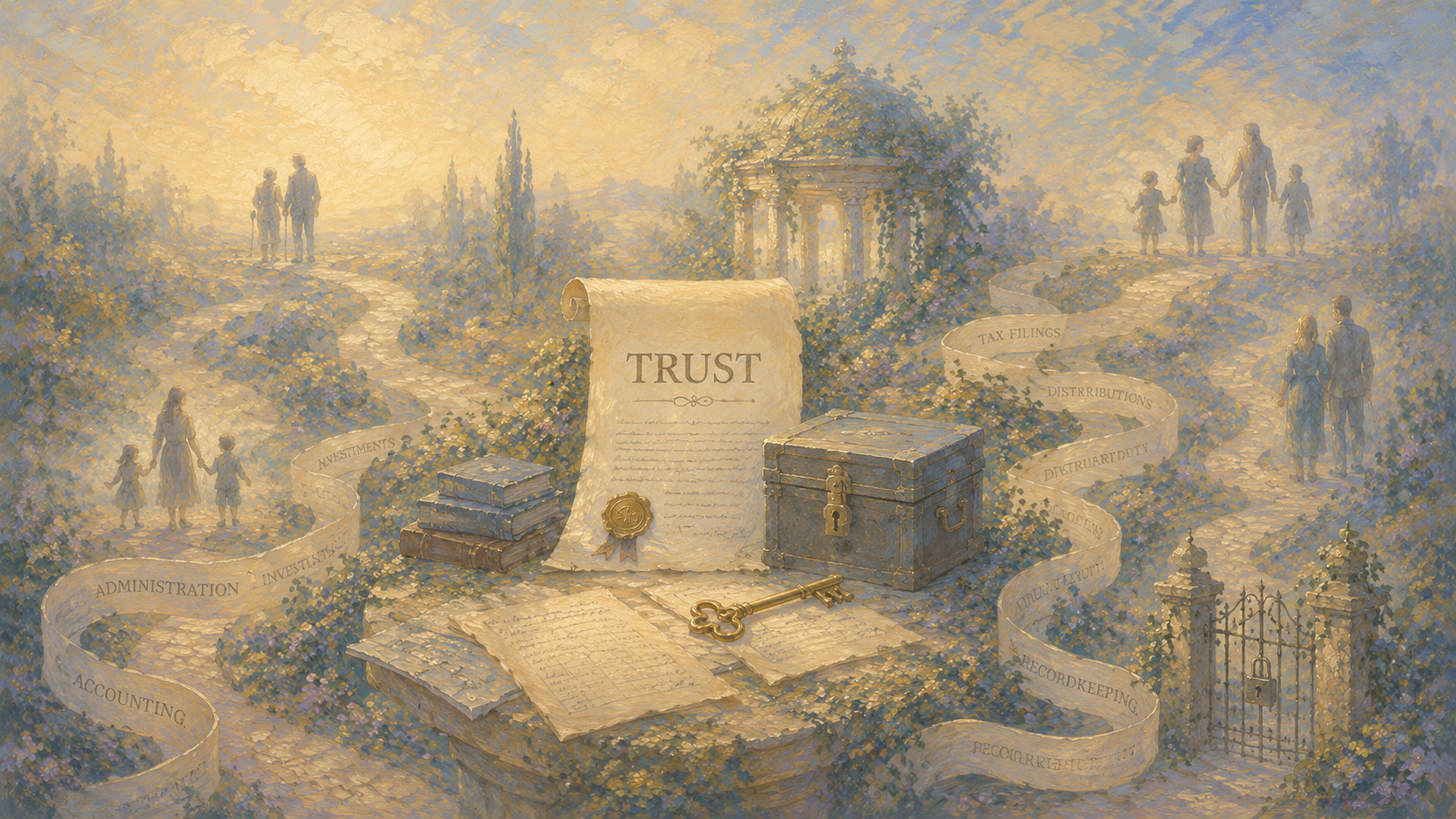
Trusts can solve real problems. But they can also preserve yesterday’s assumptions, restrict tomorrow’s beneficiaries and create an administrative burden that lasts for decades.
Trusts can help protect a vulnerable beneficiary, manage an inheritance, address the needs of a blended family, support business succession or provide continuity when someone is no longer able to manage their affairs.
These are legitimate benefits. But they’re only one side of the decision.
In my experience working with families and their financial structures, the more important question is often not What can a trust do? It is What new problems might the trust create, and who will have to live with them?
That second question matters because a trust is not merely a document drafted at a moment in time. It is an ongoing legal and administrative arrangement. Its terms may influence decisions for decades, long after the circumstances that inspired it have changed and, in some cases, after the people who designed it are no longer available to explain what they intended.
Control can look very different to the beneficiary
The ability to control how and when wealth is distributed is commonly presented as one of the principal advantages of a trust. From the perspective of the person creating it, that control may feel protective and prudent.
From the beneficiary’s perspective, however, it can feel like a handcuff.
A trust may restrict access to capital, require trustee approval for ordinary decisions or limit distributions to purposes chosen many years earlier. Those restrictions may appear sensible when the trust is created. But people and circumstances change. A beneficiary may start a business, experience a divorce, move to another country, develop a disability or face a need the original document never anticipated.
Even a carefully drafted discretionary trust cannot foresee every future circumstance. The more prescriptive its terms, the greater the risk that it will preserve the assumptions of one generation at the expense of the judgment and autonomy of the next.
This doesn’t mean control is always inappropriate. A trust can be indispensable when supporting a minor, a person with a disability or someone who is genuinely unable to manage an inheritance. But control should respond to a clearly identified risk. It should not be added simply because retaining control sounds responsible.
The trustee role is harder than it appears
Every trust also needs someone to administer it.
Trustees must understand the trust deed, exercise their discretion properly, keep records, oversee investments, authorize distributions and balance the interests of different beneficiaries. They may also have to make emotionally difficult decisions involving family members.
A relative or close friend may understand the family but lack the time, independence or technical knowledge the job requires. A professional trustee may offer continuity and expertise, but at an ongoing cost and with less intimate knowledge of the people involved. Multiple trustees can provide checks and balances, but they can also create delay, disagreement and uncertainty about who is accountable.
There is also a succession question. Who replaces the trustee in ten or twenty years? Will that person understand the original purpose of the trust? Will the beneficiaries trust their judgment? A structure intended to reduce family conflict can sometimes become a focal point for it.
A trust creates an operating burden, not just a legal bill
The cost of a trust is often discussed mainly in terms of the fee to establish it. That’s only the beginning.
Depending on the type of trust and the applicable exemptions, ongoing obligations may include:
- annual income tax and information returns;
- beneficial ownership reporting;
- bookkeeping and the retention of supporting records;
- separate banking or investment accounts;
- trustee resolutions and documentation of distributions;
- tax slips for beneficiaries;
- asset valuations; and
- continuing accounting, legal, investment-management and trustee fees.
For a large trust solving a material family problem, those costs may be entirely justified. For a smaller or lightly funded trust, the annual professional fees and administrative effort can consume much of the expected benefit.
The tax savings are often less certain than the sales pitch
Tax planning is one of the most misunderstood reasons for establishing a trust.
A trust is not automatically a tax shelter. Most trusts other than graduated-rate estates and qualified disability trusts are subject to the highest federal personal tax rate on taxable income retained in the trust, plus applicable provincial tax. Income paid or made payable to beneficiaries may sometimes be taxed in their hands, but attribution rules and the tax-on-split-income rules can prevent or reduce the expected benefit.
Many trusts are also subject to a deemed disposition of capital property every 21 years. That rule can create tax even when no asset has been sold, unless appropriate planning is completed in advance. The planning may be manageable, but it is another future obligation that must be remembered and funded.
There are situations in which a trust can produce meaningful tax or succession benefits; for example, in connection with an estate freeze or the ownership of private-company shares. But the benefit should be modelled under the family’s facts and expected costs. “Tax savings” should be expressed as a realistic range, not treated as an inherent feature of the structure.
Tax laws also change. A strategy that looks attractive when a trust is established may be narrowed or eliminated years later, while the trust and its administrative obligations remain.
For that reason, tax savings alone are often a weak foundation for a structure intended to last across generations.
Complexity is easy to add and difficult to remove
One of the most underappreciated features of financial planning is that complexity is asymmetric: it is usually much easier to add than to unwind.
Creating a trust can involve a clear project, a defined set of documents and a group of professionals working toward a closing date. Simplifying it years later may require the consent or cooperation of trustees and beneficiaries, a careful reading of the trust deed, tax analysis, asset transfers and, in some cases, court involvement. Distributing property or changing the structure can itself have tax or legal consequences.
By then, the original lawyer or accountant may be gone. Records may be incomplete. Beneficiaries may live in different jurisdictions or disagree about what should happen. What began as a solution can become a permanent part of the family’s financial machinery simply because changing it is too difficult or expensive.
This is why every proposal to establish a trust should include an exit discussion at the beginning. Under what circumstances should the trust end? How can assets be distributed? What happens if the tax benefits disappear, the family moves or the original purpose no longer exists?
If those questions cannot be answered clearly, the structure may not be ready to create.
When a trust may be worth the complexity
None of this is an argument against trusts. It is an argument for using them selectively.
A trust may be well justified when it addresses a durable, material need, such as:
- supporting a beneficiary with a disability or limited capacity;
- protecting a minor or a demonstrably vulnerable beneficiary;
- balancing the interests of a surviving spouse and children from an earlier relationship;
- implementing a carefully modelled business-succession or estate-freeze strategy;
- preserving assets where there is a genuine and legally supportable creditor or family-law concern; or
- providing continuity of management when incapacity is a significant risk.
In each case, the purpose exists independently of the trust. The trust is simply the tool chosen because it addresses that purpose better than the available alternatives.
A better set of questions
Before establishing a trust, I suggest answering the following:
- What specific problem are we solving?
- Is that problem likely to persist for many years?
- Could a will, power of attorney, beneficiary designation, shareholder agreement, insurance policy, direct gift or other simpler arrangement solve it adequately?
- How will the terms feel to the beneficiaries who must live under them?
- Who will serve as trustee, how will that person be replaced and how will disagreements be resolved?
- What are the expected annual costs in money and time?
- What tax benefit do we reasonably expect after fees, and what assumptions does that estimate depend on?
- What happens if a beneficiary moves abroad, tax law changes or family circumstances evolve?
- How can the trust eventually be amended, simplified or wound up?
The goal is not to eliminate every complication. Sometimes families and assets require appropriate structures. The goal is to ensure that every layer of structure has a clear job and that its benefits are proportionate to the restrictions, cost and ongoing work it creates.
Structure should serve the family, not the other way around
Trusts can be powerful tools. They can also outlive their usefulness.
Good planning should not be measured by how sophisticated it appears or by how many entities and documents it creates. It should be measured by whether it helps a family make better decisions, adapt to change and transfer responsibility with as little friction as reasonably possible.
Before adding a trust, families should understand not only the protection or tax benefit it may offer today, but also the burden it may place on people tomorrow. Sometimes the additional structure is worth it. Sometimes the wiser choice is to preserve flexibility and keep the plan simple.
In wealth planning, simplicity is not the absence of sophistication. Often, it is the result of it.